Colorado Springs and nearby El Paso and Teller County towns
Cracks, sticking doors, a sinking slab or a wet basement? Call or send a request to be connected with an independent Colorado Springs foundation repair contractor.
Foundation trouble in Colorado Springs usually starts quietly. A hairline crack in the basement wall gets a little wider over a summer. A door starts to rub at the top corner. The garage floor splits, a front walk tips toward the house, or a basement corner turns damp after afternoon storms. None of it feels like an emergency, but it raises a fair question: is this normal settling or is the house moving?
Colorado Springs Foundation Repair Help keeps the first step simple. It is an independent referral service, not a foundation repair company. Call or send the request form, and your request goes to an independent foundation repair contractor who serves Colorado Springs and the surrounding towns. The contractor contacts you, explains the likely cause and gives you a price before any work begins. You decide whether to go ahead. There is no charge for the referral, and callbacks and on-site availability vary.
Requests are welcome from Mountain Shadows, Cedar Heights, Rockrimmon and the Broadmoor area, Old Colorado City and the Westside, Briargate, Stetson Hills and Northgate, and from Monument, Fountain, Falcon, Woodland Park and Peyton. Every service starts the same way: one call or one form.
Colorado Springs Foundation Repair Help is an independent referral service, not a foundation repair company. It does not employ crews, own equipment, sell piers or provide engineering. When you call or send a request, it is passed to an independent, third-party foundation repair contractor who serves Colorado Springs. That contractor contacts you, looks at the problem, sets the price, schedules the work, handles any permit and backs the job with their own warranty and terms.
Using this site costs you nothing. You pay only the contractor, and only if you approve the work they quote. Callbacks and on-site availability vary.
More about us
A foundation problem is really a soil and water problem. Most damage along the Front Range comes from clay soil and bedrock that swell when they get wet, so a good repair deals with the cause as well as the crack. Each service page below covers the warning signs, how the work is done in plain terms, typical costs with their sources, the local rules that apply and the questions worth asking before you sign.
Requests are welcome from across Colorado Springs and from nearby communities in El Paso and Teller counties. Monument, Fountain, Falcon, Woodland Park and Peyton each have their own page covering the soils, housing and permit details that set them apart. Requests from Security-Widefield, Cimarron Hills, Black Forest, Gleneagle, Manitou Springs, Palmer Lake and Woodmoor are handled the same way. Coverage is always confirmed by address when the contractor follows up.
See all service areas
Your request goes to an independent foundation repair contractor who works in Colorado Springs and nearby towns.
Ask the contractor to explain why the house moved before you look at a repair price.
For major structural work, ask whether a Colorado-licensed engineer will design or review the repair.
Using this site is free. You pay the contractor only for work you approve.
The contractor you are connected with sets their own prices, so every figure here is a guide, not a quote. "Foundation repair" can mean sealing one crack or lifting a corner of the house on steel piers, so prices spread wide.
Colorado Springs figures (all read November 2026):
Those local averages do not agree, and the pages do not explain which kinds of jobs each one counts. Read them as several sources side by side, not one "true" Colorado Springs price.
National figures: Fixr (updated January 27, 2026) puts the average at $5,200, most jobs $2,200 to $8,200, and full underpinning at $10,000 to $40,000. HomeAdvisor (labeled 2025) gives an average of $5,168, most jobs $2,224 to $8,127. Both put piers at $1,000 to $3,000 each. HomeAdvisor and Angi share one cost database, so count them as one source. Each service page lists the figures for that kind of work.
What moves the price: how many piers are needed and how deep, digging and access, concrete or landscaping removed and replaced, engineering, any permit, and drainage work done at the same time. Get the price and scope in writing before work starts.

The Colorado Geological Survey calls expansive soil "Colorado's most significant geologic hazard." Clay in the soil soaks up water and swells, and the survey says soil volume "may expand 10 percent or more as the clay becomes wet." Most homes in the state sit in areas of potentially expansive clay. Of homes built on expansive soil, CGS says 60 percent will see only minor damage over their useful lives, while 10 percent will see significant damage.
Colorado Springs adds tilted bedrock: layers of claystone standing steeply on edge near the surface. The survey's heaving bedrock study says this has caused "exceptional damage to houses, roads, and utilities along the Front Range piedmont since suburban-type development began in the early 1970s." Because the layers alternate, one part of a foundation can rise while another stays put.
CGS mapped this hazard on its map of areas susceptible to differential heave (1999), which covers the western part of Colorado Springs. It warns of "destructive, differential ground heave" where expansive layers lie at shallow depth, while noting that conditions "vary considerably within the hazard area." The map is not a verdict on any single lot.
Damage is usually slow. CGS's homeowner guide to swelling soils says it "may occur slowly over time, and houses in a neighborhood may be affected at different times." That is why one house on a street can have a cracked basement while the next looks fine.
A few parts of the city also have slope and subsidence history. The survey's Colorado Springs landslide susceptibility map (2003) calls the Pierre Shale "the most problem-prone bedrock for stability concerns in Colorado Springs" and says it underlies about 88 square miles of the city. It reports that 1999 storms brought flooding and landslides, a Presidential Disaster Declaration, and FEMA buyouts of 26 homes at a cost of $6.35 million. CGS's ground subsidence page also records a major subsidence incident in April 1979 over the abandoned Klondike coal mine in the Rockrimmon area.
The city's geologic hazard code requires geologic hazard studies for development in mapped landslide and mine subsidence areas, and at building permit the City Engineer may ask for a site study when drainage changes in a landslide-susceptible area or digging goes deeper than 3 feet on a slope of 15 percent or more. The city is also working with CGS on an engineering geology study of two areas in southwest Colorado Springs. If your repair means deep digging on a hillside lot, ask your contractor whether any of this applies.

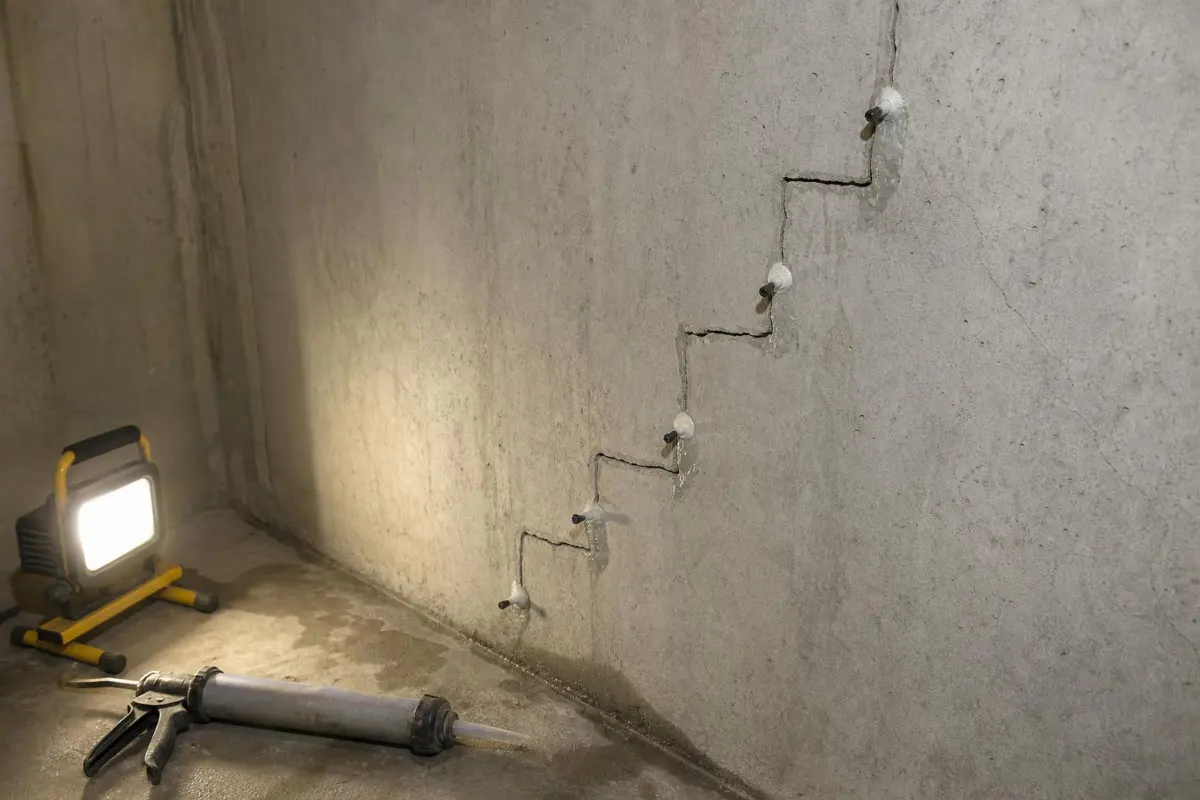
The Colorado Geological Survey's guide to building on swelling soils tells homeowners where to look: cracks in basement and garage floors, driveways and walks, cracks in walls near the corners of doors and windows, and movement at furnace ducts and utility lines. Other common signs:
One crack does not mean a failing foundation. What matters is whether cracks grow, whether several signs show up together and whether water is involved. Photograph cracks with a date and a tape measure in the shot, and check again in a few months.
Many Colorado Springs homeowners start by looking for a structural engineer, and that is often a smart instinct. To be clear: Colorado Springs Foundation Repair Help is an independent referral service, not a foundation repair company, and it does not provide engineers or engineer's reports. Requests go to a foundation repair contractor. Here is what to know if you need an engineer as well.
What an engineer's report is. A licensed engineer examines the cracks and movement, considers soil, drainage and construction, and gives a written opinion on the cause and what repair, if any, is needed. An engineer you hire yourself is not selling the repair, so many people get a report before a large job, before buying a house with cracks, or when two contractors disagree.
What it costs (national). A structural engineer's report runs $340 to $780 (HomeAdvisor, labeled 2025), $300 to $1,000 (Angi, updated May 12, 2022) or $300 to $2,000 (Fixr, updated January 27, 2026). Angi's foundation inspection guide (labeled 2025 data) shows engineers billing $100 to $200 an hour. A geotechnical (soils) report is a deeper study; HomeGuide puts it at $1,000 to $5,000 (HomeGuide; the page does not date its data).
When an engineer is usually involved. For piers, underpinning or wall stabilization, ask the contractor whether a Colorado-licensed engineer will design or review the repair, and keep a copy of the letter. PPRBD's residential remodel handout says design professionals are required for any work deemed non-conventional, and its plan review guidelines require a soils report and engineered foundation design for new homes. On tilted bedrock, CGS's heaving bedrock study says piers designed for ordinary swelling soil have proven inadequate where the bedrock wasn't studied.
How to check a license. Colorado licenses professional engineers through a state board in DORA's Division of Professions and Occupations (C.R.S. 12-120-202, unofficial reprint). Ask for the engineer's name and license number and check it with the board.
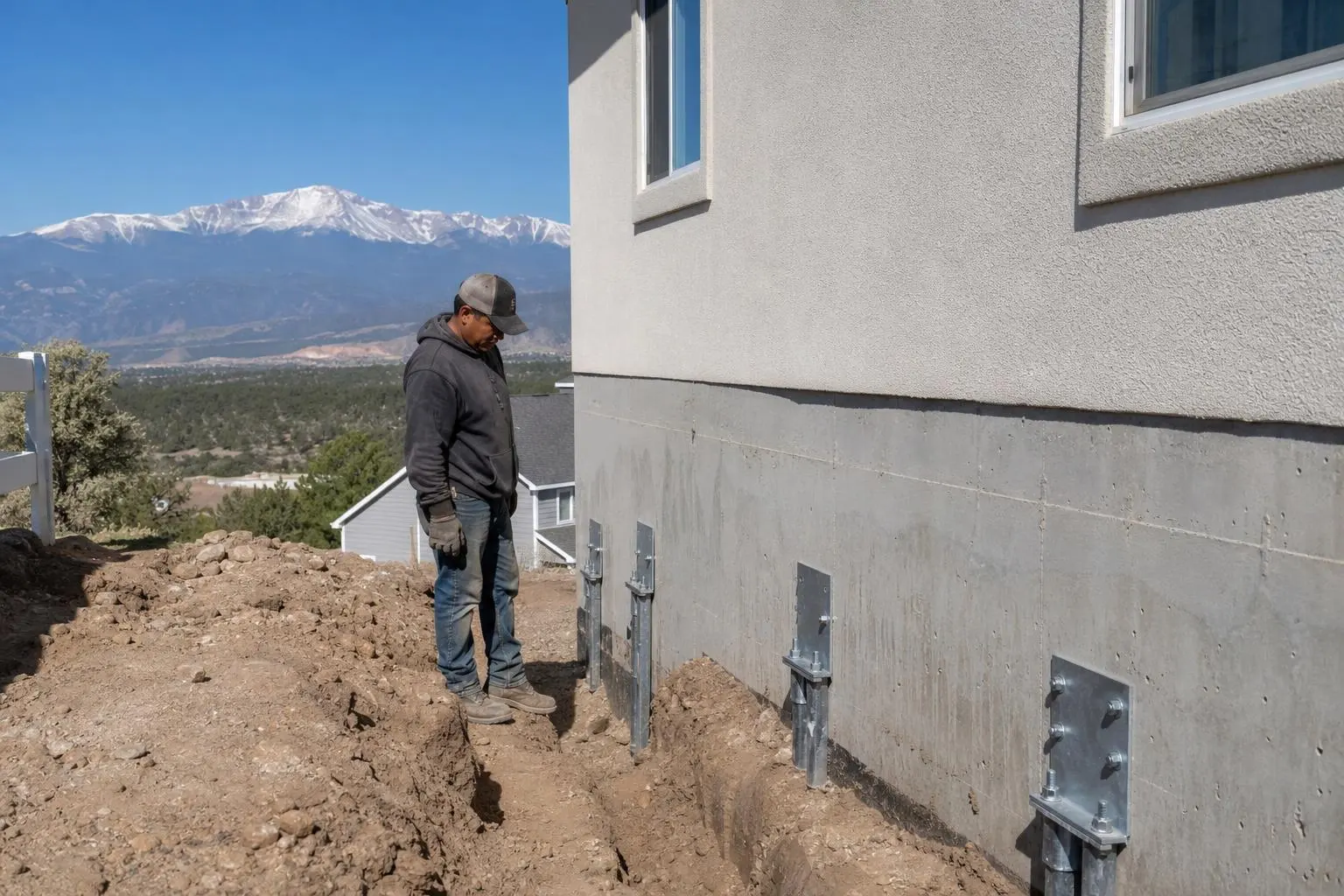
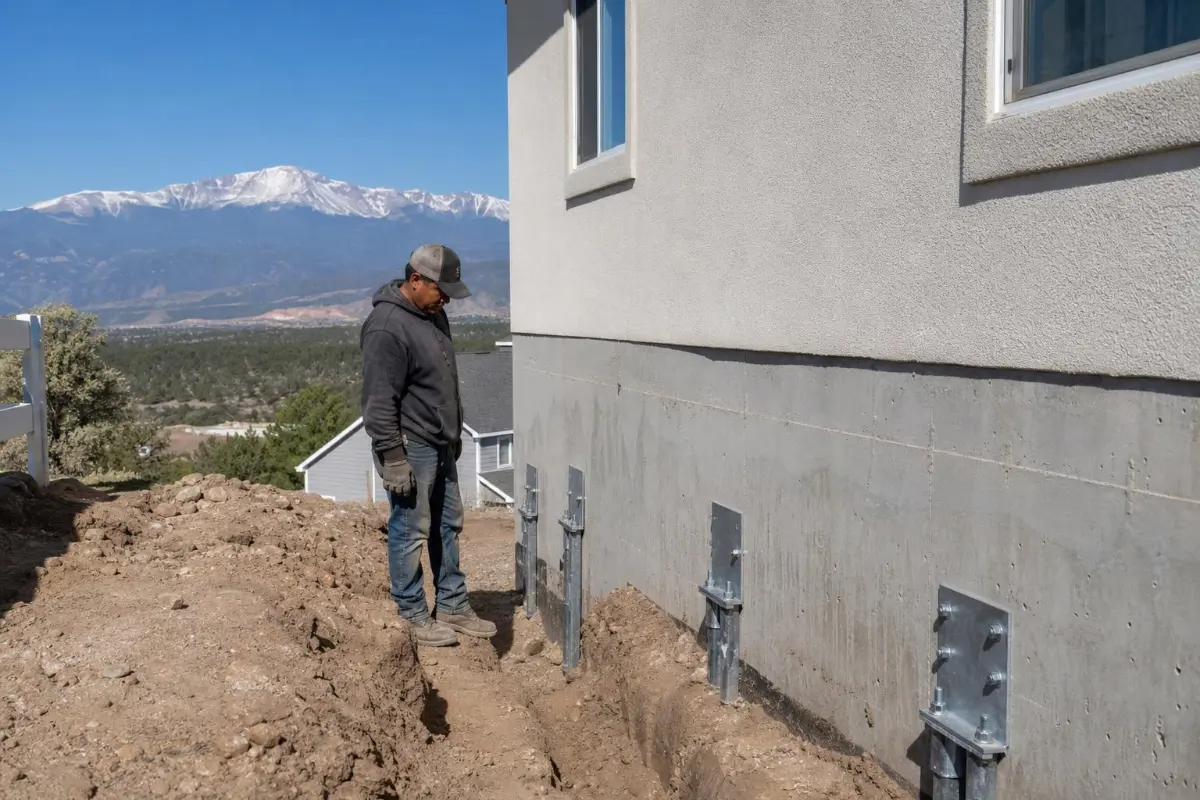
Building permits for Colorado Springs, unincorporated El Paso County, Fountain, Manitou Springs, Monument, Palmer Lake, Green Mountain Falls, Calhan and Woodland Park go through the Pikes Peak Regional Building Department (PPRBD), as El Paso County also explains.
No PPRBD page names piers, crack injection or waterproofing directly, so ask the contractor whether your job needs a permit, get the number if it does, and check the final inspection before the last payment. PPRBD's homeowner page has a contractor directory search, and its licensing FAQ explains license classes. Colorado has no state general contractor license; the Attorney General's Stop Fraud Colorado page says to check with your city or county.
1. Call or send the form. Describe what you see and how long you have noticed it. 2. A contractor follows up. An independent foundation repair contractor who serves Colorado Springs contacts you to arrange a visit. Callbacks and on-site availability vary. 3. Look and explain. The contractor looks at the problem and explains the likely cause. Many contractors offer a free estimate visit; ask when you book. 4. Written price and scope. For structural repairs, ask whether an engineer is involved. 5. Permit and repair. If the work needs a PPRBD permit, the contractor pulls it and does the work. 6. Inspection and final payment. Where a permit was pulled, check that the final inspection passed before paying in full.
You decide at every step. Nothing is done without your approval, and there is no charge for the referral.

Whether you use this site or call around yourself, these questions sort contractors quickly.
The Attorney General's Stop Fraud Colorado page lists warning signs, including "asking for more than 10% of costs up front," wanting cash, gift cards or cryptocurrency, or refusing to pull permits, and advises getting bids from at least three businesses. The AG's consumer alert also advises a written contract with firm dates and paying in installments as work is done. The 10 percent figure is guidance, not a legal cap, so read the contract's deposit terms.
Because swelling soil reacts to water, the cheapest foundation protection is keeping water away from the house. The Colorado Geological Survey's booklet, Home Landscaping and Maintenance on Swelling Soil, gives specific numbers:
Colorado State University Extension's PlantTalk on expansive soils gives the same distances and warns against removing downspout extensions to water beds by the house. The National Weather Service's Colorado Springs normals show 15.91 inches of precipitation a year, with July, August and June the wettest months, so summer storms are when grading and gutters get tested.

The U.S. Census Bureau counted about 488,664 people in Colorado Springs in mid-2023, with 61.3 percent of homes owner-occupied. The city's 2025 housing fact sheet puts the median year built at 1986 in the city and 1995 in unincorporated El Paso County.
That mix means very different foundations. Older homes in historic neighborhoods were built generations before today's rules. CGS's guide to building on swelling soils recommends drilled piers where soils swell moderately to highly, and its expansive soil page lists badly sized or "mushroom-topped" drilled piers, too little empty space under grade beams, and poor drainage among common problems. Newer homes go through PPRBD plan review, which requires a soils report and engineered foundation design.
If you bought your home new, Colorado law (C.R.S. 6-6.5-101, unofficial reprint) requires builders to give buyers a summary of the soils analysis at least 14 days before closing. Dig out that paperwork; it tells a contractor or engineer a lot. If you rent, report cracks or water to your landlord in writing.
Foundation questions differ across the city, as the city's PlanCOS neighborhood framework and CGS's maps show.
Requests are also welcome from Flying Horse, Cordera, Banning Lewis Ranch, Cheyenne Mountain Ranch, Powers, Southeast Colorado Springs and every other part of the city. Mention your neighborhood or cross streets when you call.

The same referral process covers homes outside city limits:
All of these communities fall under the Pikes Peak Regional Building Department for building permits. Coverage is confirmed by address when the contractor follows up.
Colorado Springs Foundation Repair Help does not handle insurance claims and cannot tell you what your policy covers. Coverage for foundation damage, soil movement, settling and water seeping into a basement varies from policy to policy. The Colorado Geological Survey's Colorado Springs landslide report notes that normal homeowners insurance does not cover landslide damage. Read your policy's exclusions and call your agent or insurer with questions before you assume either way, and keep dated photos of any damage.

No. Colorado Springs Foundation Repair Help is an independent referral service, not a foundation repair company. Your request goes to an independent foundation repair contractor who serves Colorado Springs. That contractor looks at the problem, sets the price, does the work and provides any warranty under their own terms.
No. The referral is free. You pay only the contractor, and only for work you approve after hearing the price.
It depends on the job. This Old House's Colorado Springs page (updated April 18, 2024) shows an average of about $2,986, while Angi's Colorado Springs page for foundation repair or raising (the page does not date its data) shows $13,224, most jobs $3,398 to $20,056. The contractor sets the price after seeing your home.
It depends on the contractor's schedule. Callbacks and on-site availability vary. Mention whether water is coming in or the problem is getting worse quickly.
No. This site does not provide engineers or engineer's reports. Professional engineers in Colorado are licensed by a state board within DORA's Division of Professions and Occupations, and you can hire one directly. National guides put a structural engineer's report at $340 to $780 (HomeAdvisor, labeled 2025) or $300 to $1,000 (Angi, updated May 12, 2022). For major structural repairs, ask the contractor whether a Colorado-licensed engineer will design or review the work.
Not every crack is. Concrete shrinks as it cures, and many hairline cracks never change. Cracks that grow, let water in, show one side pushed past the other, or come with sticking doors and sloping floors deserve a professional look. Photograph cracks with a date and check them again in a few months.
Tell us what your foundation is doing and get connected with an independent Colorado Springs foundation repair contractor.
Free — no obligations